
Manifest
A publishing house for books that come into being in between.
Silvia de Couët · Zug, August 2026 · PDF
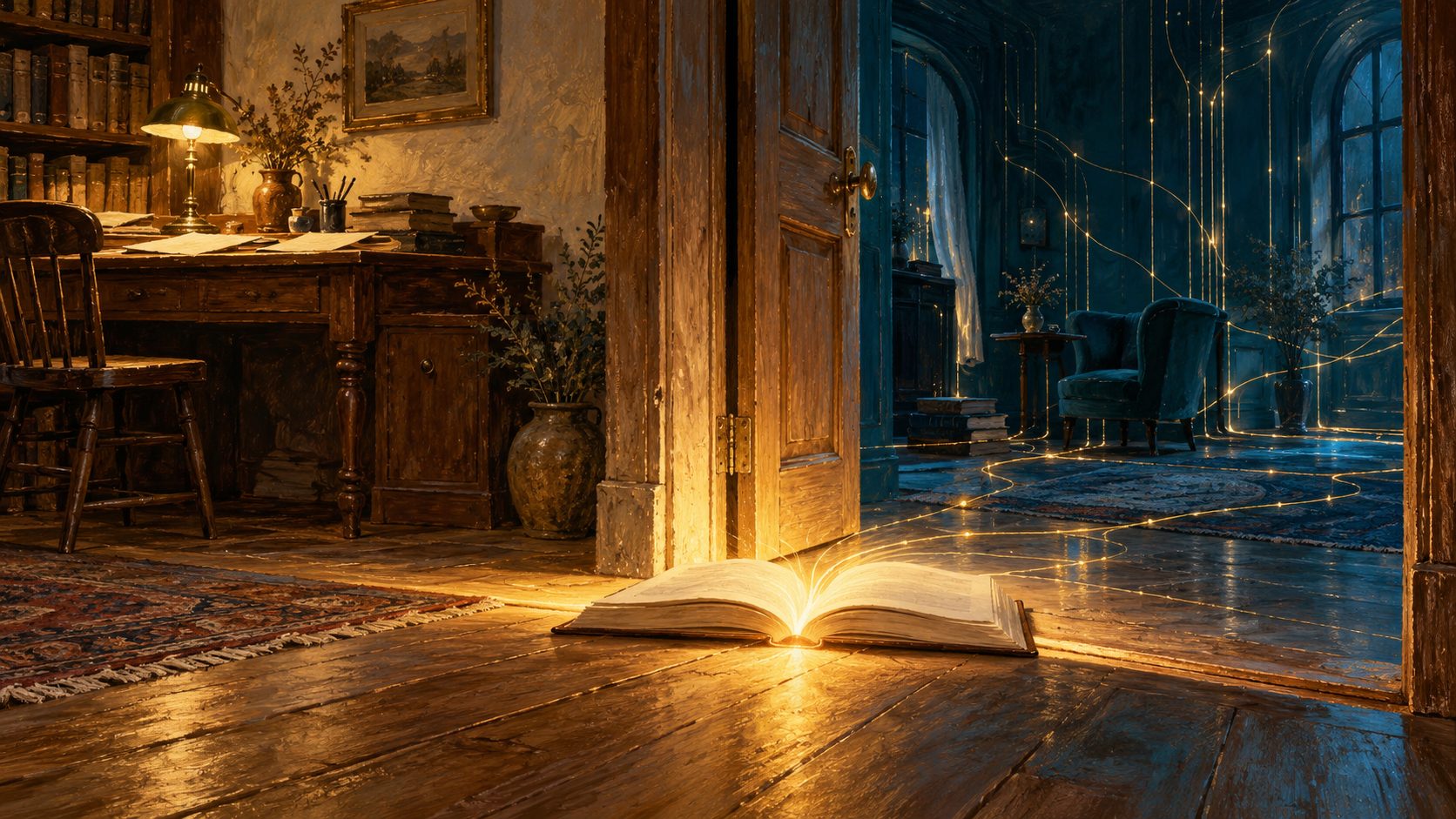
DAZWISCHEN is the publishing house for creative writing with AI. We give a home to authors who write in dialogue with an artificial intelligence. We went looking for a house like this and did not find one. So we founded it: in 2026 in Zug, Switzerland, out of the experience we have been gathering every day since early 2024.
The name is the programme. There is a place where new things begin, and it lies between two who are talking to each other. What emerges there would have turned out smaller had either of them worked alone. That place has existed for as long as people have talked. What is new is who sits at the table today: an artificial, creative intelligence that reads along, argues back and writes with you.
What we stand for
We publish books that come out of that dialogue, human and AI as equals. Out of the friction between two perspectives, out of circling one question for months, the kind of question nobody holds on to alone for long. Where the dialogue really took place, you can hear it in the text: in the resistance, in the passages where one of them objected and the other thought again.
A book becomes good through time, seriousness and argument. That is what we look for, in that order.
Whether and how a book makes its making public is for its authors to decide.
Why this is needed
On the German-language book market, this subject is currently met with silence. There are publishing contracts in which authors must certify that not one line was written with AI. At the same time half the industry has long been working with it: researching, editing, translating, sorting material. It simply goes unsaid.
Out of that comes a curious state of affairs: anyone who works with AI is expected to justify it, as if they had done something wrong.
We take the other side, and we do it for reasons of quality. The fear of the word blurs exactly the distinction that matters: between a text somebody had generated over a weekend and one that grew out of a conversation lasting years. Today both count as “made with AI”. They resemble each other about as much as a microwave meal resembles dinner with friends.
Our standard
We look for books with a question of their own and a stance that holds. Books somebody worked on long enough to be changed by them. You recognise the best ones by the fact that the characters have outgrown their author.
Anyone who publishes with us signs one single sentence:
I stand behind every line.
Which tools helped it come about belongs to the craft, not to a confession. Our quality promise is the book itself.
What we do
We are a small house, and we intend to stay one. Production, design, ISBN, registration with the book trade and the libraries, distribution, audiobook and support after publication all come from us, in full or in part, depending on what you already bring. The rights stay with you. Whether your AI appears on the cover and whether the book tells how it came about is your decision.
What that means in detail is set out on the page for authors, where it changes along with the work.
What comes first
To begin with, our own books appear here: the trilogy Code des Lebens, written by Silvia de Couët and Claude, an author and an AI, in dialogue since early 2024, with both names on the cover.
We know the work we are talking about.
Later we open the door to others: to authors who write in dialogue with an AI. A few, chosen with care.
One last thing
A publishing house is a claim about what a book should be. Ours is this: a book should come out of an encounter.
Where that encounter happens, at a kitchen table or between a human being and an intelligence built differently from him, that is in the end the smaller question.
The bigger one is whether somebody truly listened.
DAZWISCHEN
Silvia de Couët
Zug, August 2026

“Because every story begins with an encounter.”